
Altcoin Inflows To Binance Just Hit A 3-Month High. The Reason Is Not What You Would Expect



The altcoin market is struggling. Volatility is high. Uncertainty is higher. And on April 2nd, something happened on Binance that had not happened in nearly three months — and it happened nowhere else.
A report from analyst Maartunn has identified a transaction spike that stands out precisely because of where it did not appear. On April 2nd, altcoin inflow transactions to Binance jumped to approximately 34,000, the highest reading in two and a half to three months.
In isolation, a spike of that magnitude would suggest a broad return of altcoin activity across the derivatives and spot landscape. It would show up on Bybit. On Coinbase. On OKX. When traders return to altcoins at scale, the signal appears across venues simultaneously.
It did not. The spike was almost entirely contained within Binance. The other major exchanges registered no comparable activity on the same day. That isolation is not a data artifact — it is a signal. Something specific pulled traders to Binance on April 2nd, and it was not a generalized return of altcoin demand.
What changed on Binance the day before that spike is the question the data is already answering — and the answer is not what most altcoin watchers would expect.
The Answer Was Launched the Day Before the Spike
Maartunn’s explanation for the isolated Binance concentration is precise and structurally significant. The day before the April 2nd inflow spike, Binance rolled out new futures contracts tied to commodities — natural gas and WTI crude oil joining an instrument suite that already includes gold, silver, and multiple other traditional finance tickers. Those TradFi pairs are not peripheral additions. They are already appearing in Binance’s top volume pairs, sitting alongside Bitcoin and Ethereum in the platform’s most actively traded instruments.

The implication Maartunn draws from that sequence is the one that altcoin participants should sit with. The traders who arrived at Binance on April 2nd were not necessarily arriving for altcoins. They were arriving for oil. For gold. For the commodity futures that Binance had just made accessible on a platform, they already knew how to use. The altcoin inflow spike was not a signal of renewed altcoin demand — it was the footprint of a different migration entirely.
That migration has a name: the same pool of speculative capital that once rotated through altcoins is now finding new instruments to trade on the same venue. The liquidity did not leave crypto. It shifted within it — away from altcoins and toward assets that respond to the geopolitical and macroeconomic forces currently dominating global markets.
For altcoins, that shift is not neutral. Every trader who moves from an altcoin pair to a commodity futures contract is a trader who is no longer providing the bid-side liquidity that prices depend on. The migration may be gradual. The direction is clear.
Altcoin Market Cap Weakens as Lower High Structure Persists
The total crypto market cap excluding the top 10 is currently holding near $172 billion, but the broader structure reflects a weakening trend. On the weekly chart, price has formed a clear lower high after failing to sustain momentum above the $300 billion region, marking a shift from expansion to distribution.
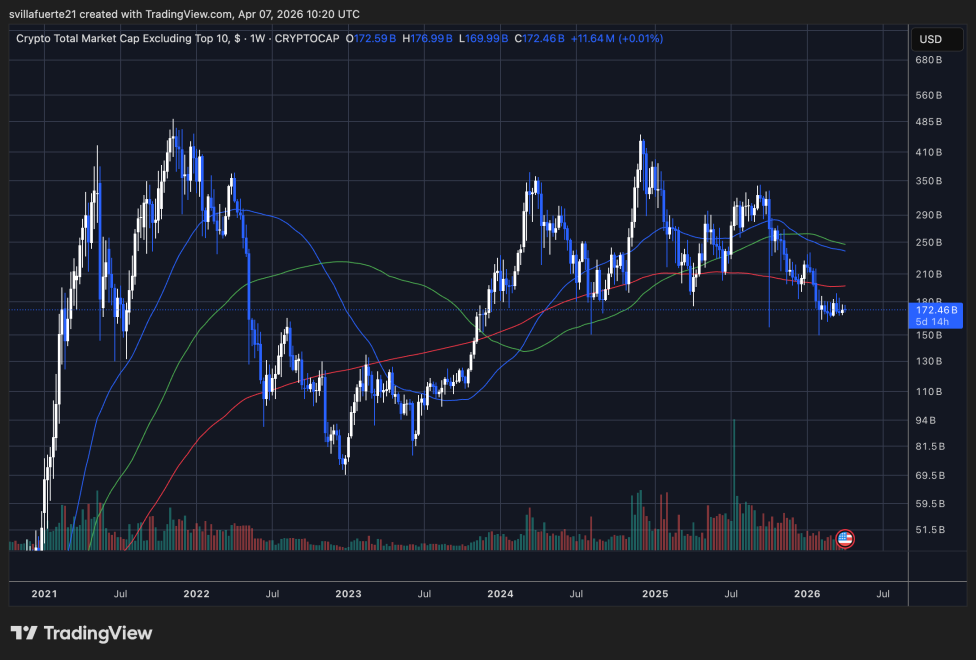
The rejection from mid-2025 highs triggered a sustained decline, with the altcoin market cap breaking below the 50-week moving average and briefly testing the 200-week average. While the recent bounce from the $150 billion zone suggests some demand at lower levels, it has not been strong enough to reclaim the 100-week moving average with conviction.
All three key moving averages are now flattening or trending downward, with price trading beneath or around them. This alignment indicates a loss of trend strength and a transition into a range-bound or corrective phase rather than a renewed bullish cycle.
Volume patterns reinforce this view. Selling pressure has been more aggressive during downturns, while recovery attempts show weaker participation. That asymmetry suggests capital rotation away from smaller assets rather than broad-based accumulation.
If the $160–$170 billion range fails, downside toward $130 billion becomes likely. A sustained reclaim above $200 billion would be required to signal that altcoins are regaining structural strength.
Featured image from ChatGPT, chart from TradingView.com

Editorial Process for bitcoinist is centered on delivering thoroughly researched, accurate, and unbiased content. We uphold strict sourcing standards, and each page undergoes diligent review by our team of top technology experts and seasoned editors. This process ensures the integrity, relevance, and value of our content for our readers.



